
Most organisations are more agile than they realise—and less scalable than they think.
If your organisation followed its own processes exactly as designed, delivery would probably slow down. That is not a failure of execution. It is a signal.
Because in most organisations, work does not flow through the system as intended. It flows around it.
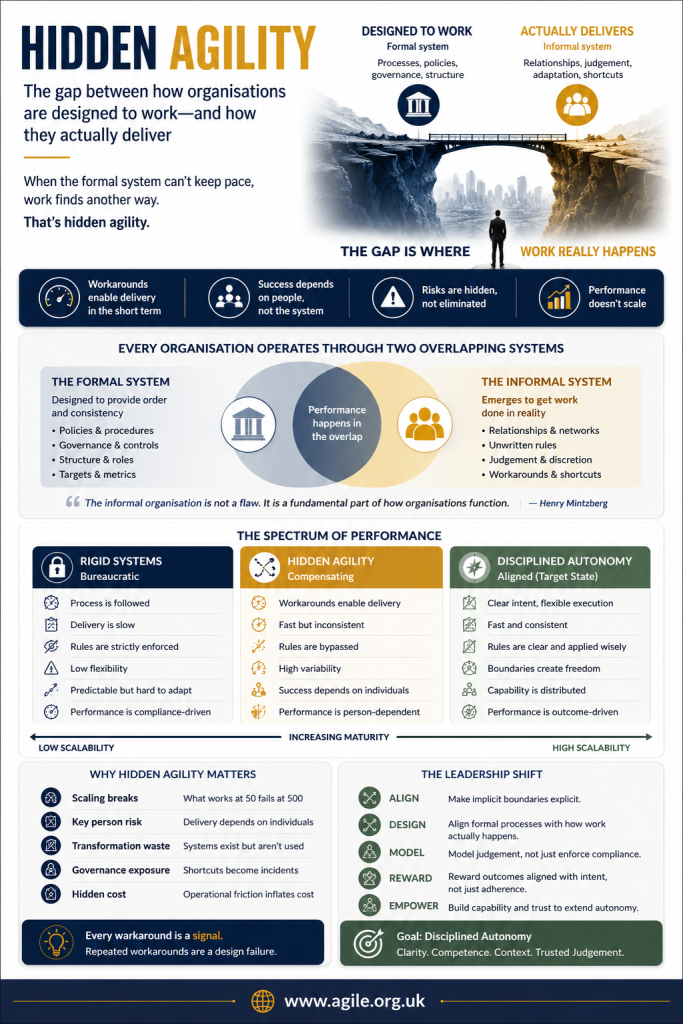
Hidden agility is the gap between how organisations are designed to work—and how they actually deliver.
At first, that gap looks like adaptability. Teams find ways to remove obstacles, accelerate decisions and keep work moving. Over time, however, something more significant happens. The organisation stops relying on its operating model and starts relying on the people working around it.
That distinction matters more than most leaders realise.
The System Behind the System
Most leaders focus on process—how work should flow. Yet organisational performance is rarely determined by process alone.
Every organisation operates through two overlapping systems. The formal system consists of governance, policies, structures and defined processes. Alongside it sits an informal system made up of relationships, judgement, trust and the unwritten rules people learn over time.
As management scholar Henry Mintzberg observed, “the informal organisation is not a flaw. It is a fundamental part of how organisations function.”
The implication is profound. Organisations do not run on process alone. They run on how people interpret it.
A useful illustration comes from NASA’s Apollo Programme. NASA became famous for engineering rigour and procedural discipline, yet mission success frequently depended on collaboration, judgement and informal problem-solving beyond documented procedures. The lesson was not that process failed. The lesson was that process and judgement worked together. High performance emerged because the formal and informal systems reinforced one another.
The same principle applies in modern organisations.
When processes become too slow, too complex or too disconnected from reality, work does not stop. It moves into conversations, relationships and trusted networks. Decisions are made through judgement rather than procedure. Delivery continues, but increasingly outside the system that was designed to support it.
That is where hidden agility emerges.
When Workarounds Become the System
Consider a familiar scenario.
A critical product launch is at risk. The formal process requires tickets to be raised, priorities to be reviewed and governance approvals to be secured. In reality, someone contacts a senior engineer directly, a decision is made within minutes and the issue is resolved.
The product ships on time. The organisation celebrates delivery. And few people stop to ask how delivery actually happened.
What leaders often believe is happening is structured, controlled execution. What is actually happening is that informal networks are compensating for limitations in the formal system.
A simple test reveals the pattern. If decisions happen faster in messages than in meetings, your organisation is running on hidden agility.
This is not necessarily a problem. Every organisation develops informal ways of getting things done. The problem arises when those informal mechanisms become more effective than the official ones.
Every organisation has unwritten rules. The question is whether they reinforce the formal system—or replace it.
When written and unwritten rules align, organisations scale. People understand both the boundaries and the freedoms available to them. Judgement complements process.
When written and unwritten rules conflict, workarounds emerge. Over time, those workarounds become dependencies. Success depends less on the system and more on the individuals who know how to navigate around it.
That is the point at which hidden agility becomes fragile.
From Hidden Agility to Disciplined Autonomy
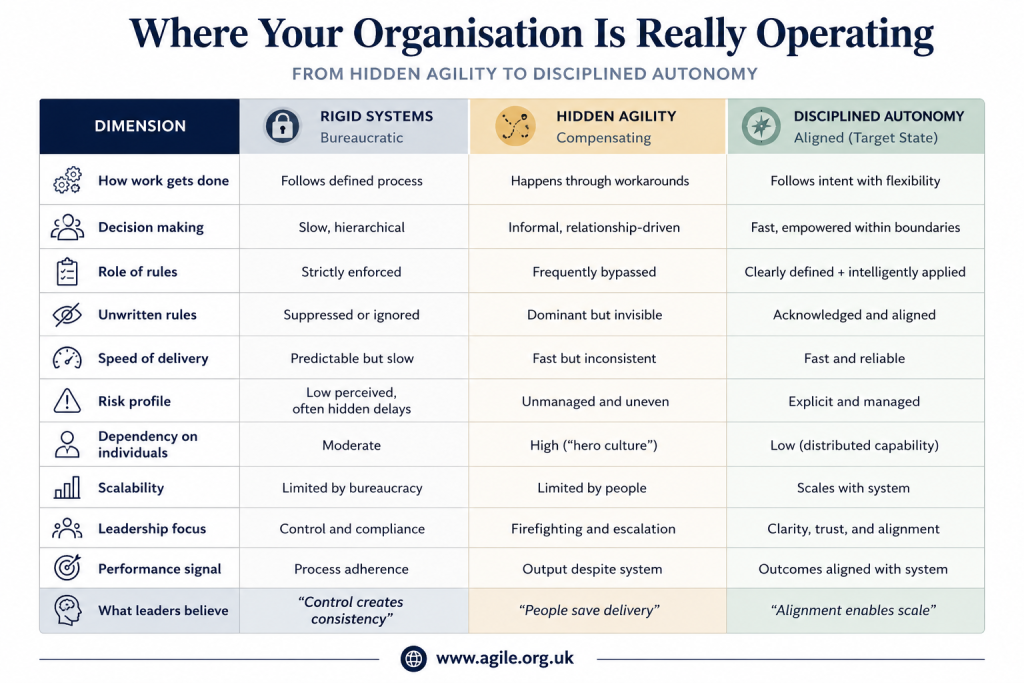
Most organisations exist somewhere between rigidity and autonomy.
At one end of the spectrum, process dominates. Delivery is predictable but slow. At the other end, people operate with clear boundaries, trusted judgement and the freedom to make decisions close to the work.
Between these two states lies hidden agility—the place where workarounds, personal influence and informal networks compensate for the shortcomings of the operating model.
Most transformation programmes attempt to solve this challenge by introducing additional governance, controls or process. Ironically, hidden agility often exists because there is already too much of all three.
The goal should not be to eliminate flexibility. It should be to design for it. This is where disciplined autonomy becomes important.
Disciplined autonomy is not freedom from rules. It is freedom within boundaries. It is the ability to exercise judgement while remaining aligned to organisational intent.
High-performing organisations rely less on enforcement and more on trusted judgement. They are clear about what cannot be compromised while allowing flexibility everywhere else. People understand not only the rules but also the purpose behind them.
As Reed Hastings famously observed, “People do well when they are trusted, not when they are controlled.”
The most effective organisations operate according to a simple principle: Control at the edges. Freedom in the middle.
This is where rigidity and flexibility stop competing and start working together.
The Hidden cost of Hidden Agility
Hidden agility often creates the illusion that everything is working.
Projects are delivered. Deadlines are met. Customers remain satisfied.
Yet beneath the surface, people are compensating for weaknesses in the system. Processes are being bypassed. Risks are being absorbed rather than managed. Operational friction becomes hidden cost.
The danger is that leaders see the outcomes but not the effort required to achieve them. As organisational psychologist Amy Edmondson has noted, “When people feel unable to speak up about problems, organisations lose the ability to learn.”
Hidden agility does not solve organisational problems. It often conceals them.
This becomes particularly visible during growth. What works with fifty people often breaks with five hundred. Informal networks cannot scale indefinitely. Heroics become bottlenecks. Key individuals become single points of failure. Organisations discover that their apparent agility was actually dependency.
A useful question for any leadership team is this: “If your highest-performing teams disappeared tomorrow, would your operating model still deliver the same outcomes?”
The answer reveals whether performance is embedded in the system or hidden inside individuals.
Final thought
Every organisation has hidden agility. The question is whether it exists as a temporary adaptation or a permanent dependency.
The organisations that scale best are not the most controlled. They are the most aligned. They understand that performance emerges when formal systems and informal behaviours reinforce one another.
Hidden agility is not the problem. Hidden dependency is.
Because if people have to work around the system to deliver, the system isn’t working.