
Imagine walking into a boardroom and telling executives that their transformation strategy has more in common with a casino than a project plan. Most would be horrified.
After all, gambling is associated with chance, uncertainty and risk. Agile, on the other hand, is supposed to bring control, predictability and better outcomes.
Yet the most successful agile organisations and the most successful professional gamblers share an identical mindset:
They never bet everything on being right.
That may sound provocative, but this is how modern organisations succeed in uncertain environments.
Agile Is a Risk-Management Framework, Not a Delivery Method
Agile is often described as a project management methodology or a software development approach. But that definition is too narrow.
At its core, agile is a risk-management framework that uses rapid experimentation, feedback and adaptation to make better decisions under uncertainty.
And that is where the comparison with professional gambling begins. Not because both involve chance. But because both involve making decisions when certainty is impossible.
This interpretation is supported by the original principles behind the Agile Manifesto, which emphasise early and continuous delivery, frequent releases, welcoming changing requirements and regularly adjusting how teams work. Each principle creates an opportunity to discover problems, test assumptions and change direction before too much time or money has been committed.
The official Scrum Guide, written by Scrum co-creators Ken Schwaber and Jeff Sutherland, makes the connection with evidence-based decision-making explicit:
“Empiricism asserts that knowledge comes from experience and making decisions based on what is observed.”
That is fundamentally a risk-management principle. Instead of assuming that an initial plan is correct, teams expose their assumptions to reality and use the results to decide what should happen next.
This also explains why understanding what agile working really means requires looking beyond ceremonies, stand-ups and sprint boards. Agile working is ultimately about how organisations structure decisions, distribute responsibility and respond to new information.
The Biggest Gamble Is Often the Traditional Plan
Many organisations assume that agile is risky because it embraces experimentation.
The reality is often the opposite. The biggest gamble isn’t experimentation. It is spending two years executing a plan written before the market changed.
Traditional management assumes the future can be predicted accurately enough to design the perfect roadmap. Agile starts with a different assumption:
The future is uncertain, so build systems that learn faster than change occurs.
That mindset has become increasingly important across digital industries, particularly in sectors where customer behaviour, technology and regulation evolve rapidly.
Official GOV.UK guidance on agile delivery advises teams to deliver iteratively, use data from real users, release regularly and “fail fast and learn quickly”. The guidance explains that frequent releases make it possible to identify problems earlier, improve visibility, control costs and avoid creating services that become too large or politically difficult to stop.
The same guidance on agile governance and risk management acknowledges that risks cannot be eliminated. Instead, teams should identify important risks, respond at the right moment and make frequent, evidence-based decisions.
The traditional plan therefore does not remove risk. It can simply delay the moment at which the organisation discovers that its assumptions were wrong.
This problem is often intensified by the organisation design gap: the distance between an organisation’s stated desire to become agile and the structures, incentives and approval processes through which work is actually controlled. A team may be told to experiment while still being required to follow fixed annual plans, obtain multiple layers of approval and deliver against targets established before new evidence emerged.
What Professional Gamblers Understand About Success
A professional poker player doesn’t expect to win every hand. They expect to make better decisions than their opponents over time.
The objective isn’t perfection. The objective is improving the odds. Professional gamblers rely on:
- Probability rather than certainty
- Discipline rather than emotion
- Evidence rather than assumptions
- Long-term outcomes rather than short-term wins
High-performing agile organisations operate in exactly the same way. They understand that success rarely comes from being right every time. It comes from creating a system that learns continuously.
Professional gamblers also understand position sizing and bankroll management. A player may believe that an opportunity is favourable, but that does not justify risking everything on a single outcome. Exposure is deliberately limited because even a good decision can produce a bad short-term result.
Agile organisations apply the same logic by releasing investment incrementally. Funding, attention and resources can be increased as evidence strengthens, rather than being committed entirely before customers or market conditions have tested the idea.
Research published by McKinsey on leading agile transformations reported that agile organisations can develop products five times faster, make decisions three times faster and reallocate resources more quickly. McKinsey also argues that quick, inexpensive experiments can prevent much larger and more costly business failures.
Speed alone, however, is not enough. Teams need leadership support, decision-making authority and protection from organisational pressures that pull them back towards old behaviours. This is why agile needs champions who can advocate for the necessary cultural and structural changes rather than treating agility as a temporary delivery initiative.
Why This Resonates Strongly in iGaming
This is why the comparison feels particularly relevant within the iGaming industry.
Online casino platforms, sportsbook operators and gaming technology providers are built around probability, risk and behavioural analysis. They understand something many organisations struggle to accept:
Certainty is an illusion.
Every day, digital gaming businesses make decisions based on incomplete information. Player behaviour changes. Competition evolves. Technology advances. Regulatory requirements shift.
Success comes not from predicting every outcome correctly, but from responding faster than competitors when conditions change.
That is agility in its purest form.
In iGaming, even apparently small changes can produce consequences that are difficult to predict in advance. A revised onboarding journey may improve registration completion while reducing the quality of acquired customers. A promotional mechanic may increase immediate engagement while creating longer-term retention, compliance or responsible-gambling concerns.
Controlled experiments allow operators to measure these effects before rolling changes out across an entire platform or customer base. The objective is not merely to move faster. It is to reduce the cost of being wrong.
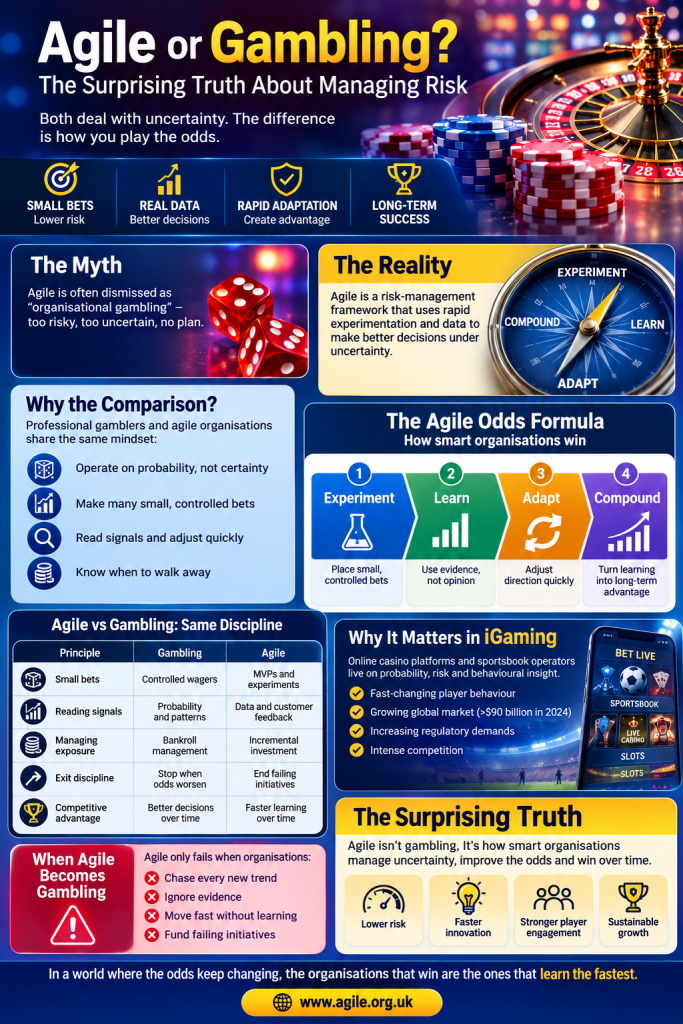
The Agile Odds Formula
The relationship between agile and professional gambling can be summarised in a simple framework:
Experiment
Place small, controlled bets. Rather than committing significant resources upfront, test assumptions through pilot programmes, MVPs and limited releases.
Learn
Use evidence, not opinion. Collect real-world data from customers, users and operational performance.
Adapt
Adjust quickly. Change direction when evidence suggests a better path.
Compound
Turn learning into advantage. Small improvements accumulated over time create significant competitive gains.
This is the same principle that drives successful product innovation, player engagement strategies and digital gaming growth.
The compounding stage is particularly important. A single experiment may deliver only a modest improvement, but an organisation that repeatedly identifies, tests and scales better decisions can build a substantial advantage over time.
Competitors can often copy a feature. It is much harder to copy an organisation’s ability to learn consistently.
Agile vs Gambling: Where the Similarities End
Of course, agile is not gambling. The objective is not to rely on luck.
The objective is to reduce uncertainty through learning.
| Principle | Professional Gambling | Agile Organisations |
| Small bets | Controlled wagers | MVPs and experiments |
| Reading signals | Probability and patterns | Data and customer feedback |
| Managing exposure | Bankroll management | Incremental investment |
| Exit discipline | Stop when odds worsen | End failing initiatives |
| Competitive advantage | Better decisions over time | Faster learning over time |
Both systems recognise risk. The difference is that agile is specifically designed to reduce it.
There is another important distinction. Professional gambling operates within a probability system that is largely fixed. Organisations can actively influence their odds by improving products, developing capabilities, changing processes and responding to customer needs.
Agile does not merely help an organisation calculate the odds. It helps the organisation change them.
When Agile Becomes Gambling
There is, however, a point where agile can start to resemble bad gambling. It happens when organisations:
- Chase every new trend
- Ignore evidence they dislike
- Move quickly without learning
- Continue funding initiatives that clearly are not working
- Confuse activity with progress
That isn’t agility. It’s simply organisational impulsiveness.
Mature agile organisations understand that knowing when to stop can be just as valuable as knowing when to start.
The warning is important because the language of experimentation can sometimes be used to excuse poor discipline. Launching multiple initiatives without clear hypotheses, success measures or stopping criteria does not create learning. It creates noise.
A controlled agile experiment should establish what the organisation expects to learn, what evidence will be collected and what outcome would justify continuing, changing or stopping the initiative. Without those controls, experimentation can become indistinguishable from repeatedly placing hopeful bets.
The Scrum Guide reinforces this discipline through its three empirical pillars: transparency, inspection and adaptation. Work and outcomes must be visible, progress must be examined frequently and changes must be made when results move outside acceptable limits.
The Surprising Truth
Casinos understand something that many organisations forget. Success rarely comes from predicting every outcome correctly. It comes from managing risk better than everyone else.
Agile works for exactly the same reason. Not because it eliminates uncertainty. Not because it guarantees success. But because it transforms uncertainty from a threat into a source of competitive advantage.
The organisations that thrive in uncertain markets are not the ones that make the biggest bets. They are the ones that learn the fastest.
And in a world where the odds keep changing, that may be the most valuable capability of all.