Why Adaptability is the Defining Advantage of Modern Organisations
The modern workplace is entering an era where stability is becoming temporary.
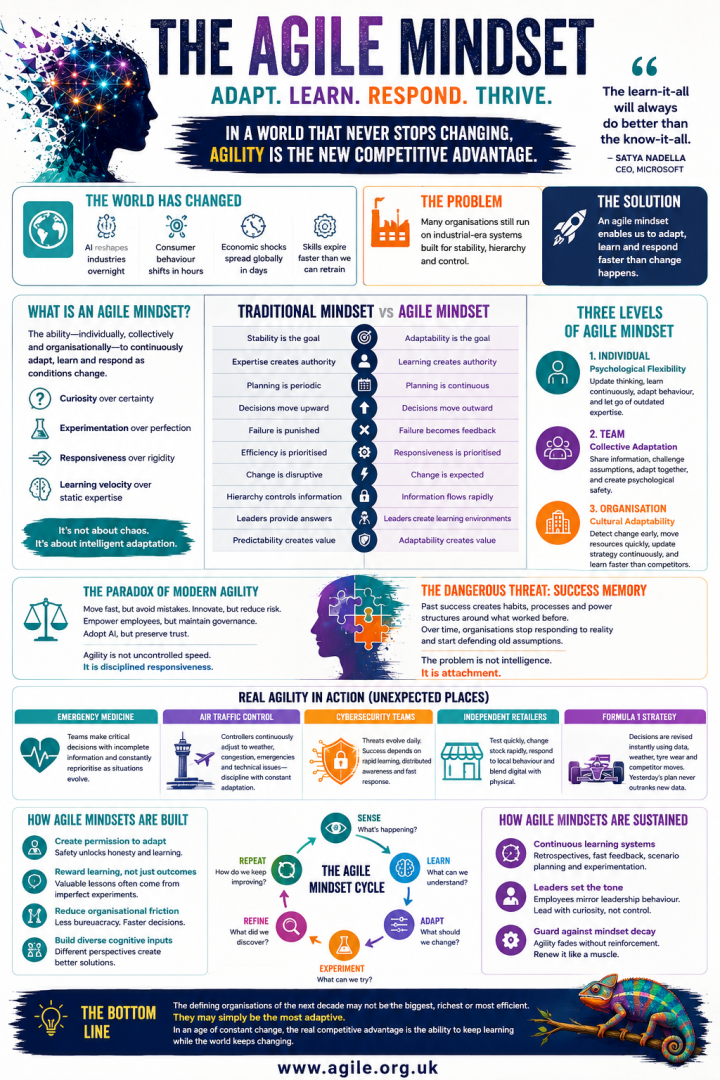
AI reshapes industries overnight. Consumer behaviour shifts in hours. Economic shocks spread globally within days. Skills become outdated faster than many organisations can retrain. Even public trust can rise or collapse in real time.
Yet much of corporate management still operates using systems designed for a slower industrial world built around predictability, hierarchy and control. That mismatch is becoming increasingly dangerous.
For most of modern business history, organisations were rewarded for efficiency. The logic was simple: optimise operations, reduce variation, scale successfully and protect what works.
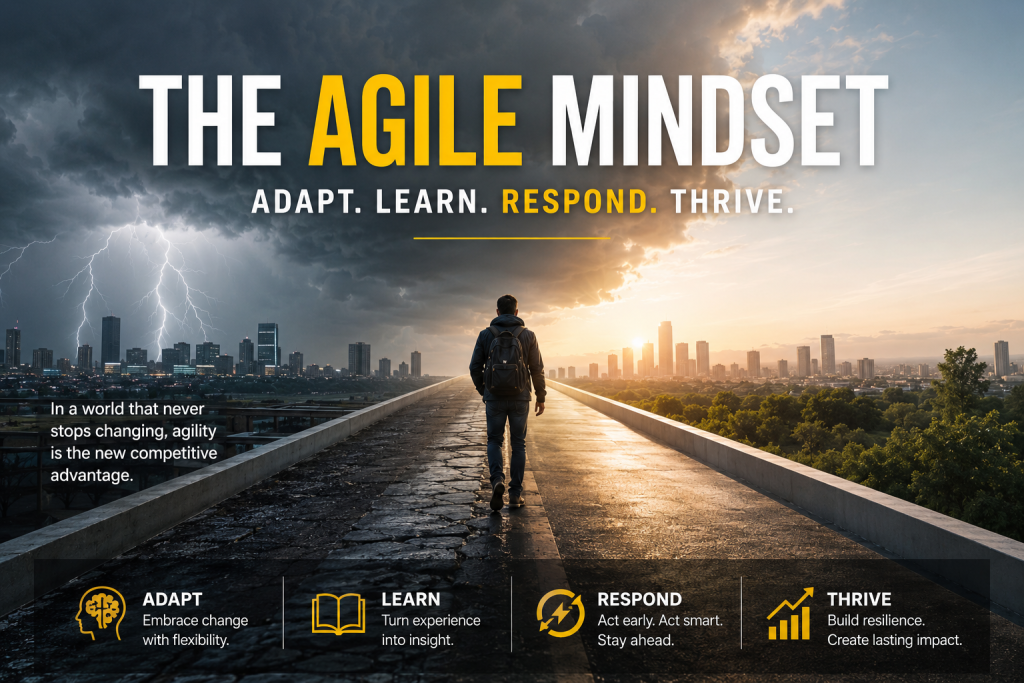
But today the environment behaves differently. Markets move faster. Technology evolves continuously. Planning cycles collide with uncertainty before execution even begins.
The challenge is no longer simply how efficiently organisations operate. It is how intelligently they adapt. This is why agility is no longer just a project methodology or innovation slogan. It is becoming a survival mindset.
As Satya Nadella, CEO of Microsoft observed, “The learn-it-all will always do better than the know-it-all.” That sentence captures the essence of modern agility more clearly than most management books.
What Agile Mindset Really Means
An agile mindset is the ability — individually, collectively and organisationally — to adapt continuously as conditions change.
At its core, it prioritises curiosity over certainty, responsiveness over rigidity and learning over ego. It does not reject structure or discipline. In fact, highly agile organisations are often extremely disciplined. What changes is the relationship with certainty.
Traditional organisations were designed like railways: fixed, optimised and predictable. Agile organisations increasingly resemble navigation systems, continuously recalibrating as conditions shift around them.
The goal is not chaos. The goal is intelligent adaptation before circumstances force adaptation.
Historically, competitive advantage came from scale, control and operational efficiency. Increasingly, it comes from learning speed, responsiveness and the ability to update assumptions quickly. That shift changes how organisations think, behave and lead.
Traditional Mindset vs Agile Mindset
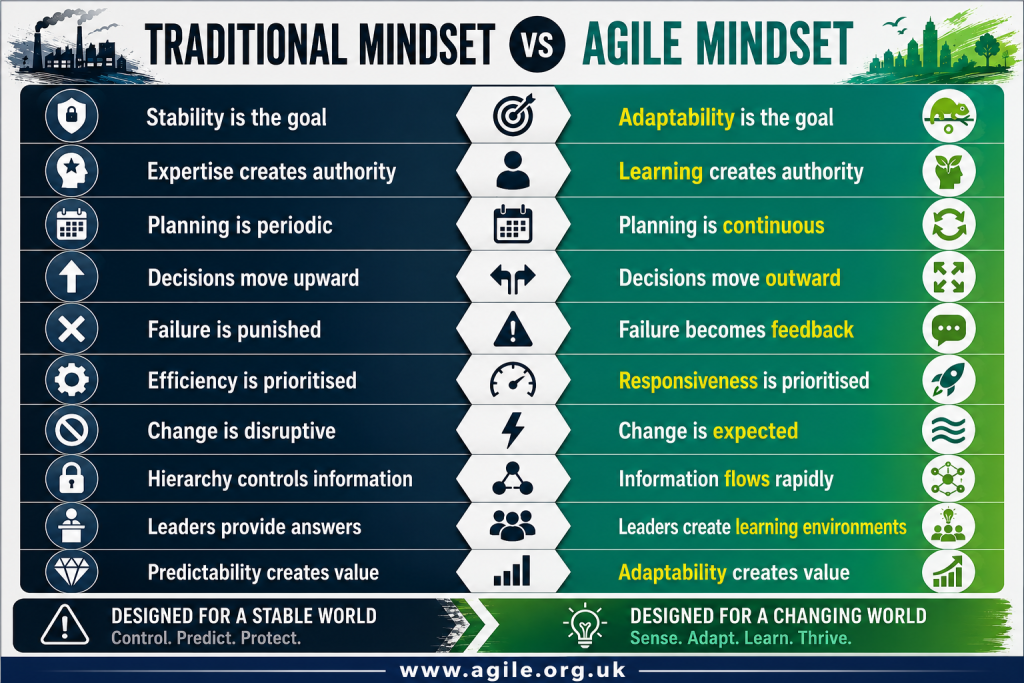
The implications of this shift are profound because most organisations are still psychologically attached to the older model. The problem is not intelligence. It is attachment.
Many successful companies spent decades refining systems built for stability. Those systems generated growth, scale and efficiency. Over time, however, they also created habits, incentives and leadership cultures that struggle to respond when reality changes quickly…. So success itself can become a trap.
Why Traditional Management Is Struggling
Industrial-era management was designed for continuity. It rewarded standardisation, control and risk reduction because markets moved slowly enough for those approaches to work effectively. But today organisations operate in a far more volatile environment.
AI models evolve monthly. Social platforms can reshape customer behaviour overnight. Geopolitical events disrupt supply chains instantly. Employees increasingly expect flexibility, autonomy and meaning rather than rigid career structures.
The result is a growing tension between the speed of the external world and the slower rhythms of internal decision-making.
Many organisations still attempt to navigate modern turbulence using structures built for calmer conditions. That is why so many transformation programmes struggle. They often introduce agile language while preserving cultures built around certainty and control.
Employees are encouraged to innovate, but punished for visible mistakes. Teams are asked to move quickly, but trapped inside approval structures designed to minimise deviation. Eventually the contradiction becomes impossible to hide.
Agility Begins with Individuals
At an individual level, agility is deeply psychological. It is the ability to update thinking without defensiveness, learn continuously and remain effective while conditions shift around you. For decades, careers rewarded consistency and specialisation. Today they increasingly reward reinvention.
The most agile people are rarely the loudest or most confident. They are usually the fastest learners. They seek feedback early, adapt quickly and treat mistakes as information rather than embarrassment.
That sounds simple in theory. In practice it is emotionally difficult because human beings naturally become attached to expertise, habits and certainty. This is why agile mindset is fundamentally about humility. The willingness to say, “What if my current assumptions are no longer correct?”
Few environments demonstrate this better than emergency medicine. Doctors and nurses constantly reprioritise decisions using incomplete information while conditions change around them in real time. No shift unfolds exactly as expected. Yet effective teams remain functional because they continuously reassess reality rather than rigidly defending earlier assumptions.
Modern organisations increasingly face similar conditions.
Agile Teams Behave Differently
Agile teams are not simply groups of talented individuals. They operate differently under pressure. Information moves faster. Problems surface earlier. Assumptions are challenged more openly. Decision-making becomes more distributed because waiting for certainty takes too long.
This is where psychological safety becomes critical. Amy Edmondson, whose work transformed modern leadership thinking, observed, “Fear is the enemy of learning.”
That insight explains why many organisations struggle to become genuinely adaptive. Employees often fear exposing problems, questioning assumptions or admitting uncertainty because traditional corporate cultures historically rewarded appearing confident rather than being responsive.
The consequence is delayed truth. And delayed truth becomes extremely expensive in fast-moving environments.
Air traffic control offers a striking example of disciplined agility. Controllers continuously adapt to changing weather, congestion, technical problems and emergencies. The system itself is highly structured, yet adaptation happens continuously within it.
That balance increasingly defines high-performing teams: disciplined enough to remain stable, adaptive enough to respond quickly.
Corporate Agility Is Ultimately Cultural
Organisational agility is not created through software tools, innovation workshops or new job titles. It is cultural. It determines whether organisations can detect change early, redistribute resources quickly and adapt before competitors do.
This is where many companies fail. They attempt to install agile practices while preserving industrial-era assumptions about hierarchy, control and information flow.
But agility cannot thrive in cultures where:
- decisions move slowly,
- information is protected,
- experimentation is punished,
- or leadership mistakes become politically dangerous.
Many organisations still optimise for a world that has already disappeared. But the future now increasingly belongs to organisations capable of balancing structure with responsiveness, discipline with experimentation and speed with trust.
The Paradox of Modern Agility
Modern organisations now face contradictory pressures simultaneously.
They must innovate faster while reducing risk. They must adopt AI while preserving trust. They must empower employees while maintaining governance. They must become more adaptable while remaining operationally resilient. This creates a new kind of leadership challenge.
But agility is not reckless speed. In fact, some of the most agile environments in the world are also highly controlled. Formula 1 strategy teams constantly revise decisions using telemetry, weather conditions and competitor behaviour in real time. Cybersecurity teams operate in permanent adaptation mode because threats evolve continuously. Independent high street retailers often adjust faster than large chains because fewer organisational layers separate reality from decision-making.
In each case, agility comes from responsiveness rather than chaos. The risk is no longer change itself. The risk is delayed adaptation.
Agile Mindsets Naturally Decay
One of the least discussed realities of organisational agility is that it naturally weakens over time.
Success creates routines. Routines harden into process. Process gradually becomes bureaucracy. Eventually organisations stop responding to reality and start defending the systems that once made them successful.
The reality is that agility behaves less like a transformation project and more like physical fitness. It requires continual reinforcement through learning, experimentation and exposure to challenge.
The moment organisations become too comfortable, adaptation begins to slow. And when adaptation slows during periods of rapid change, vulnerability rises quickly.
This is why truly adaptive organisations continuously re-examine themselves. They reduce unnecessary friction, reward learning rather than political caution and expose themselves to diverse perspectives instead of intellectual conformity.
The goal is not permanent disruption. It is avoiding permanent rigidity.
The Next Era of Agile Thinking
The next phase of agility will not be defined by speed alone.
For years organisations pursued extreme efficiency. The pandemic exposed the fragility of many of those systems. AI is now accelerating another shift by compressing learning cycles, reducing barriers to disruption and changing skill relevance faster than many institutions can respond.
The organisations that thrive over the next decade may not be the fastest. But they will be the fastest learners capable of maintaining trust during continuous change.
That represents a major leadership shift. The old model assumed leaders provided answers. Modern agile leadership increasingly creates environments where organisations can sense change early, learn continuously and adapt before disruption becomes crisis.
Efficiency created scale. Adaptability may now determine survival.
Conclusion: The Real Meaning of Agile Mindset
Ultimately, agility is not about moving faster. It is about remaining relevant while reality keeps changing around you.
That requires organisations to adapt without losing direction, learn without losing confidence and evolve before circumstances make change unavoidable.
For most of modern corporate history, businesses were rewarded for control. The next decade may reward something very different: the ability to navigate uncertainty without becoming paralysed by it.
Because in a world where technology, economics, politics and human behaviour shift continuously, the real competitive advantage is no longer certainty.
It is the ability to keep learning while the world keeps changing.













1 Comment