Manufacturing and logistics environments are under constant pressure to do more with less space, less downtime and tighter delivery windows. Production lines evolve, product mixes change and customer expectations continue to rise. In this climate, operational agility is no longer a competitive advantage. It is a requirement.
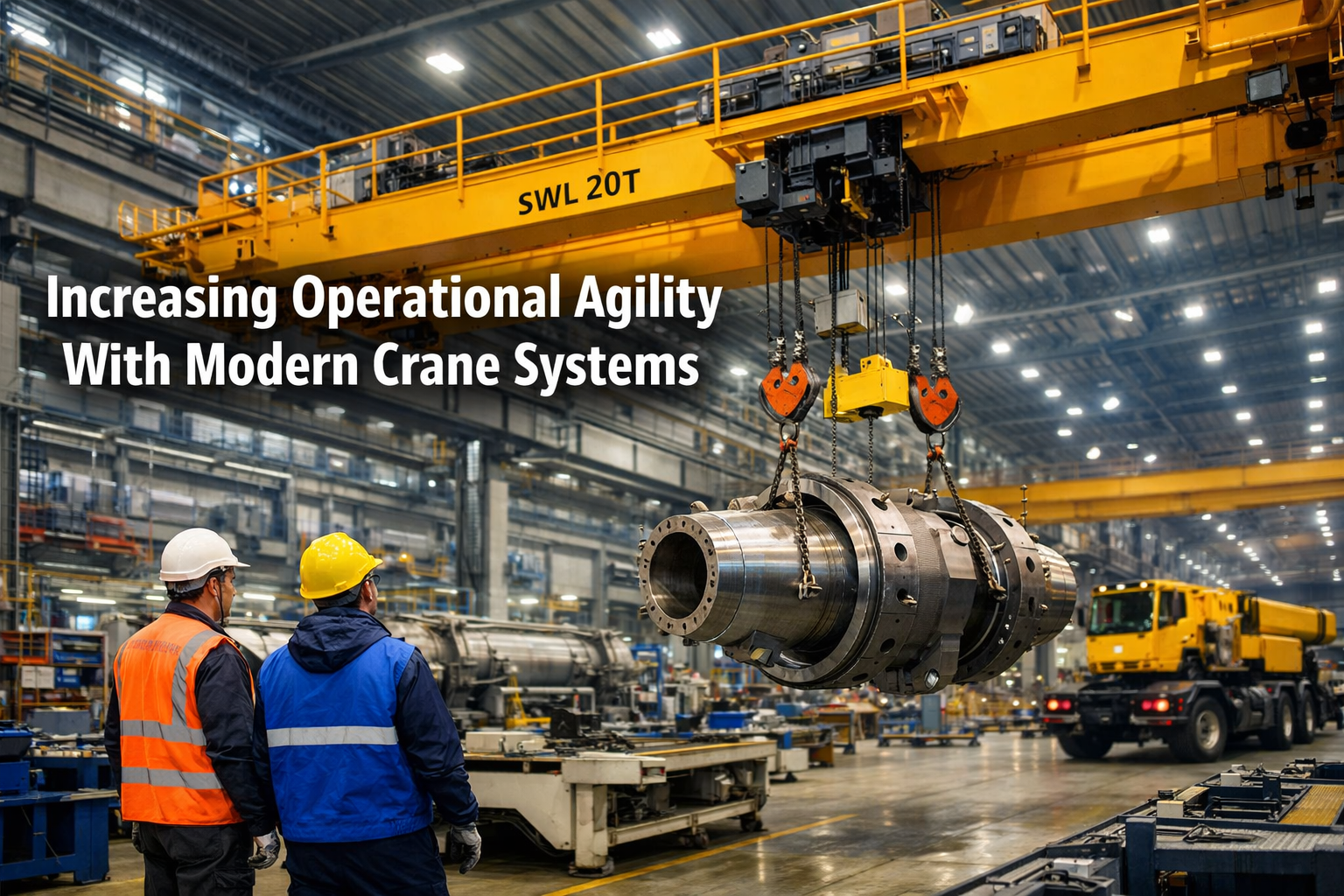
Modern crane systems play a central role in creating that agility. When specified and integrated correctly, they enable faster material flow, safer handling and the flexibility to adapt layouts and processes as demands shift.
Designing for Flexible Layouts and Future Change
Operational agility starts with infrastructure that does not restrict future development. Traditional fixed lifting points can quickly become bottlenecks as production volumes increase or workflows are reconfigured.
Contemporary overhead systems are designed with modularity in mind. Bridge cranes can span large production areas, while supplementary lifting solutions allow specific workstations to operate independently. This layered approach reduces reliance on a single crane and prevents local tasks from delaying wider operations.
Localised systems such as jib cranes provide targeted coverage around machinery, assembly benches or loading areas. By positioning lifting capability exactly where it is needed, they minimise unnecessary crane travel and reduce waiting time for shared assets. This improves workflow continuity and shortens cycle times without major structural alterations.
Future-proofing also means considering headroom, hook approach and building interfaces at the design stage. Cranes that maximise available lift height and optimise runway positioning allow facilities to introduce taller equipment or different product formats later without wholesale redesign.
Smarter Control for Precision and Throughput
Agility is not only about physical reach. It is also about motion control and repeatability.
Modern crane systems increasingly use variable frequency drive technology to deliver smooth acceleration and controlled deceleration. This enables precise load positioning, reduces load swing and limits mechanical stress on components. In fast-paced environments, predictable motion profiles help maintain consistent takt times and improve overall equipment effectiveness.
Programmable speed settings and adjustable braking characteristics allow cranes to be tailored to specific applications. For example, delicate components may require micro-speed positioning, while bulk materials demand rapid but stable travel. By matching performance to task requirements, operations can increase throughput without compromising safety.
Advanced monitoring features further enhance agility. Usage counters, thermal protection and diagnostic feedback provide visibility of crane health. Maintenance can then be planned around actual usage rather than fixed intervals, reducing unexpected downtime and allowing production managers to plan with greater confidence.
Supporting Lean and Ergonomic Operations
Operational agility must also account for people. Inefficient lifting processes place strain on operators and create unnecessary movement across the shop floor.
Integrating dedicated lifting systems into individual work cells reduces manual handling and shortens material transfer distances. Operators spend less time waiting for shared equipment and more time adding value. This aligns closely with lean manufacturing principles, where eliminating wasted motion and delays is essential.
Ergonomically designed lifting equipment improves control and reduces fatigue. Smooth, predictable motion and intuitive controls help operators handle loads safely, even during high-frequency lifting tasks. Over time, this contributes to lower injury risk and more consistent performance.
Clear demarcation of lifting zones and thoughtful crane placement also support safer pedestrian flow. When lifting systems are positioned strategically, they complement rather than disrupt wider site logistics.
Agility as a Long-Term Strategy
Increasing operational agility is not about installing more equipment. It is about investing in the right crane systems, configured to support current production while allowing room for change.
By combining flexible layouts, intelligent control and operator-focused design, modern crane systems enable facilities to respond quickly to new products, higher volumes and evolving customer demands. In an industrial landscape defined by change, that adaptability is what keeps operations efficient, resilient and ready for what comes next.