

Because Frameworks Don’t Transform Organisations — People Do
“Culture is not an initiative. Culture is the enabler of all initiatives.”
— Larry Senn
Agile does not fail because people resist change. It fails because organisations expect change without changing who holds power, how decisions get made, or what success actually means.
Most transformations do not collapse. They drift. The language changes. The behaviour does not. Agility becomes theatre.
That is why agile needs champions. Not framework guardians. Not process enforcers. Champions. People who make change visible, practical and difficult to reverse.
First Define It Properly: What Is an Agile Champion?
An agile champion is someone who turns agile from a programme into organisational behaviour.
It is rarely a title. Sometimes it is an executive. Sometimes a manager. Sometimes the most influential person in the room has no authority at all.
Champions ask uncomfortable questions:
- Why does approval still take weeks?
- Why are customers missing?
- Why do decisions travel upward?
- Why are teams measured on output instead of outcomes?
- If we started again tomorrow, would we organise work like this?
Champions convert intent into action and momentum into habit.
If Agile Is Valuable, Why Does It Need Champions?
Most organisations are designed for reliability while Agile is designed for adaptation. The relative differences naturally create tension.
Most organisations rewards predictability, governance, standardisation, annual planning, visible control and avoiding failure
Agility introduces alternatives such as experimentation, customer proximity, shorter decisions, iterative learning and local ownership.
Without champions, agility slowly becomes administration. Processes get renamed. Reports look modern. Delivery stays the same.
The Evidence Is Surprisingly Consistent: Change Is Mostly Human
Transformation research repeatedly arrives at the same conclusion. Structures matter. Technology matters. Operating models matter. But people determine whether change survives.
Prosci the leading change management organisation consistently identifies active and visible sponsorship as one of the strongest indicators of successful change.
Project Management Institute and McKinsey & Company continue to highlight leadership behaviour and employee adoption as differentiators between transformation programmes that accelerate and those that stall.
As Margaret Wheatley observed: “People support what they help create.”
Organisations do not become agile when structures change. They become agile when behaviour survives high stakes pressure.
What Extraordinary Agile Champions Actually Do
Most articles stop at saying champions are important. That misses the point.
The strongest champions perform a surprisingly consistent set of roles regardless of industry, maturity or operating model.
The table below summarises the seven behaviours that repeatedly separate agile programmes that survive from those that slowly become process theatre.
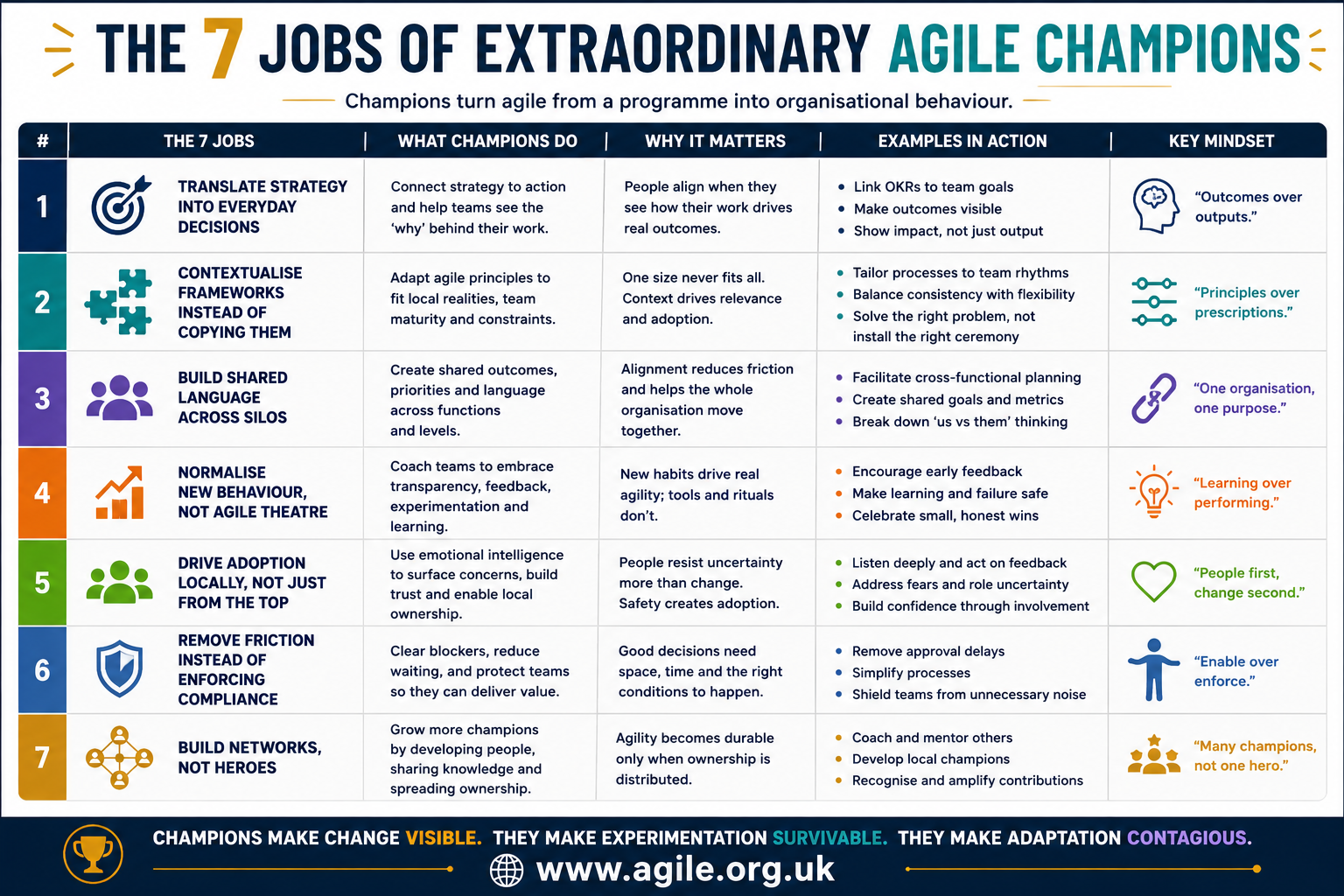
The table simplifies the roles. In reality, the strongest champions move between them constantly—translating, protecting, connecting and enabling depending on what the organisation needs next.
Translate Strategy Into Everyday Decisions
Champions connect ambition to behaviour.
They help teams understand why work matters and help leaders see what outcomes are actually being created.
Great champions do not manage activity. They reduce the distance between decisions and results.
Contextualise Frameworks Instead of Copying Them
Frameworks do not scale through replication.
Finance is not engineering. Operations is not marketing. Strong champions adapt principles locally without losing intent. They ask:
What problem are we solving—not which ceremony are we installing?
Build Shared Language Across Silos
Agile often breaks at organisational boundaries.
Functions optimise locally. Champions create shared outcomes. Shared priorities. Shared language. Because organisations only move quickly when teams move together.
Normalise New Behaviour
Agility is not created by tools.
It appears when people become comfortable:
- exposing unfinished work
- seeking feedback earlier
- testing assumptions
- admitting uncertainty
- learning publicly
New habits create real agility. Tools do not.
Drive Adoption Locally
Large transformations often underestimate social risk.
People ask: Will I lose influence? Will my role change? Is this another management initiative?
Champions surface anxiety early. Build trust. Gather honest feedback.
People rarely resist change. They resist uncertainty.
Remove Friction Instead of Enforcing Compliance
Transformation rarely moves backwards openly. It returns disguised as sensible management.
Approval layers reappear. Governance expands. Decision cycles lengthen.
Workplace psychologist Nigel Oseland has frequently argued that organisations redesign systems while underestimating behaviour.
Champions remove blockers. Protect teams. Create conditions where better decisions become easier.
Build Networks, Not Heroes
Many transformations fail because one person becomes the transformation. Then that person leaves.
Extraordinary champions create more champions. They develop informal leaders. Share ownership. Reward experimentation.
As systems thinker Peter Senge observed: “The bottleneck is always at the top of the bottle.”
Agility only becomes durable when ownership spreads.
What Real Champions Look Like
Spotify’s influence came less from structures and more from leaders translating autonomy into everyday behaviour.
Continuous improvement became durable because problem solving became normal work—not a specialist programme.
That behaviour is what champions create.
Government Digital Service (UK)
Its biggest shift was cultural.
Internal advocates challenged procurement, governance and service assumptions—not just technology.
Progress started with people.
The Champion Paradox
The strongest champions eventually become harder to see.
At first they challenge. Then they coach. Then they disappear into the system.
Success is not when people follow the champion. Success is when they stop needing one.
If agility disappears when one person leaves— it was never embedded.
Five Signs You Don’t Have Agile Champions
□ Teams escalate decisions they could make themselves
□ Decisions repeatedly move upward
□ Ceremonies multiply but outcomes do not
□ Customer feedback arrives too late
□ Momentum disappears when transformation leaders move on
If three or more feel familiar you probably have agile activity rather than agile capability.
Summary
Organisations continue searching for the perfect framework. The perfect operating model. The perfect transformation playbook.
But agile has never really been a process problem. It has always been a courage problem.
Agile does not spread through frameworks. It spreads through behaviour.
Champions make change visible. They make experimentation survivable. They make improvement normal. And perhaps the best reminder comes from Margaret Mead:
“Never doubt that a small group of thoughtful, committed citizens can change the world; indeed, it is the only thing that ever has.”
The best agile champions do not leave behind perfect frameworks.They leave behind organisations that improve before being told. That may be the clearest sign agility has become real.