
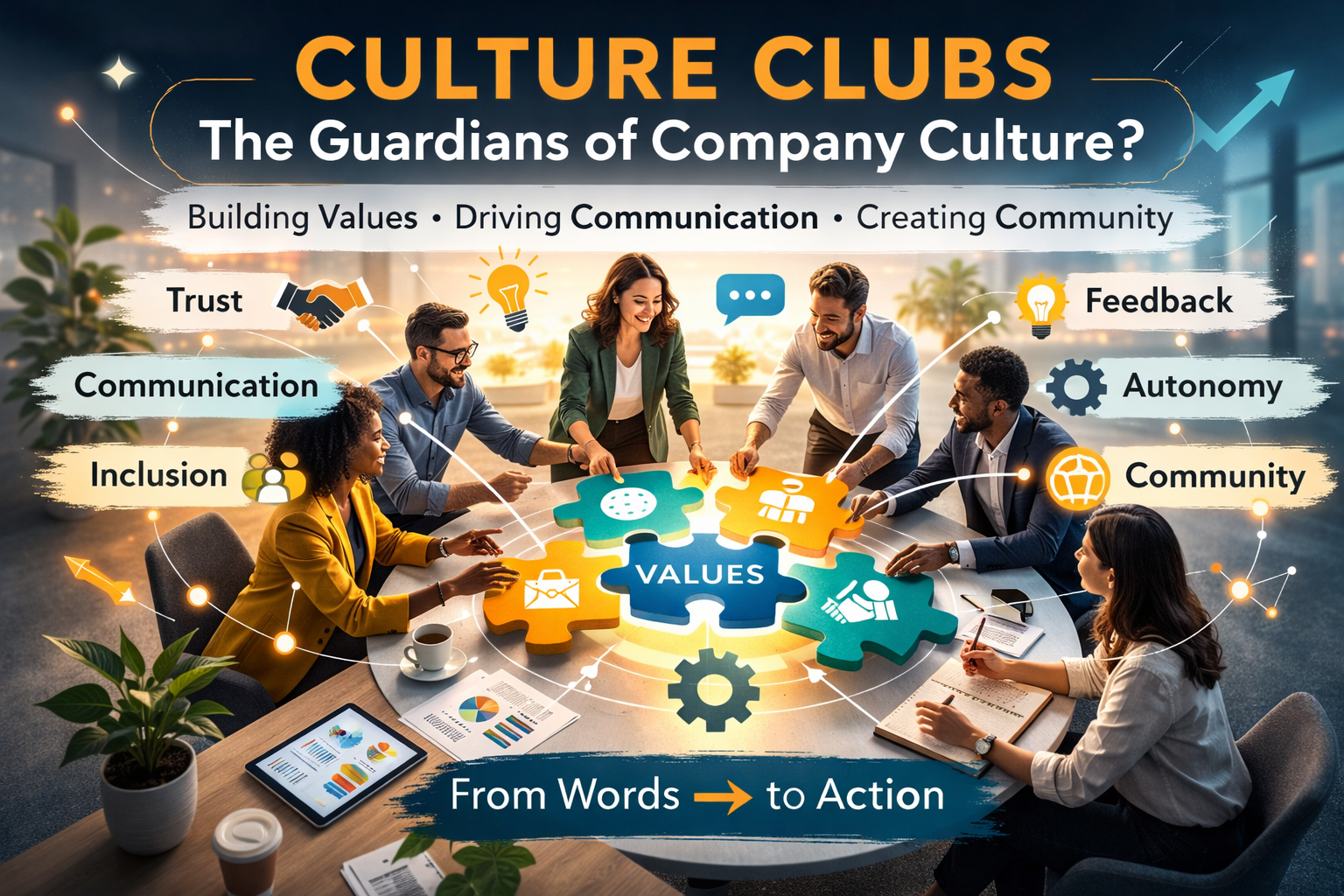
A culture club is an employee-led group inside a company that actively designs, protects and evolves workplace culture through initiatives, rituals, communication channels and feedback loops.
Instead of culture being defined solely by executives or HR policies, culture clubs create a distributed model of culture leadership — where employees themselves become the stewards of how a company behaves, collaborates and communicates.
Increasingly, forward-thinking organisations are discovering that culture cannot be mandated. It must be practised, communicated and maintained by the people inside the organisation. That broader idea — that culture cannot be built through top-down messaging alone — is also reflected in management writing from Harvard Business Review.
Culture clubs are one way to operationalise that idea.
Why Culture Matters More Than Ever
Organisational culture is no longer a “soft” topic. It is a strategic asset. In hybrid workplaces, distributed teams and fast-moving markets, culture is the invisible operating system that shapes how decisions are made, how people treat each other and how quickly organisations adapt.
Management thinker Peter Drucker captured this reality in one of the most quoted observations in management:
“Culture eats strategy for breakfast.”
The implication is simple but profound. Strategy may define direction, but culture determines whether people actually move in that direction together.
The importance of workplace culture is reinforced by global research on employee engagement. According to Gallup’s 2025 State of the Global Workplace, global employee engagement fell from 23% to 21% in 2024, costing the world economy an estimated US$438 billion in lost productivity.
These findings underline why organisations increasingly treat culture not as a soft concept but as a measurable driver of performance, wellbeing and retention.
What Is a Culture Club?
A culture club (sometimes called a culture committee or engagement council) is a cross-functional group of employees responsible for shaping and sustaining workplace culture.
Typical responsibilities include:
• organising community and learning events
• strengthening internal communication
• promoting company values and behaviours
• creating recognition programmes
• supporting inclusion and belonging
• providing feedback to leadership
• connecting teams across the organisation
The purpose is not simply morale. It is active culture stewardship.
Examples of Culture Clubs in Action
Boldspace — A Formal “Culture Club”
The communications agency Boldspace describes a workplace model where its culture club manages internal events and social initiatives while an inclusion council focuses on diversity and belonging.
The lesson: culture needs owners — not just slogans.
Zoom — The “Happy Crew”
At Zoom, the company highlights internal initiatives such as global celebrations, mentoring programmes and volunteering opportunities as part of its culture focused on connection and employee wellbeing.
Microsoft — Employee Culture Networks
Another powerful version of a culture club is the employee resource group. Microsoft’s official Pride announcement describes how its GLEAM network (Global LGBTQIA+ Employees and Allies at Microsoft), founded in 1993, has helped support inclusion across the organisation.
What begins as a voluntary community can evolve into a meaningful force shaping organisational culture.
The Real Role of Culture Clubs
When they work well, culture clubs perform several important organisational functions.
1. Translators of Values — and Communication Bridges
Companies often publish values such as innovation, collaboration or integrity. But values written on posters do not change behaviour.
Culture clubs translate those ideas into everyday organisational practices.
| Organisational Value | Culture Club Practice | Cultural Outcome |
|---|---|---|
| Collaboration | cross-team lunches and knowledge-sharing sessions | stronger internal networks |
| Recognition | peer-to-peer appreciation programmes and awards | increased motivation |
| Inclusion | employee networks and listening circles | stronger sense of belonging |
| Transparency | open Q&A forums and town halls | improved trust |
| Learning | mentoring schemes and skill-sharing workshops | continuous development culture |
Culture clubs can also serve as two-way communication bridges, helping leadership explain strategy and values while bringing employee insights back to leadership.
That idea — culture as something owned by everyone in an organisation — is also reflected in Harvard Business Review’s discussion of shared culture responsibility.
2. Early Warning Systems
Because culture club members come from across departments, they often detect organisational issues before leadership does.
They may hear early signals about:
• morale concerns
• communication breakdowns
• burnout or workload pressure
• inclusion or fairness issues
This makes culture clubs a potentially valuable early warning system for organisational health.
3. Community Builders
Humans are social creatures, even at work.
Culture clubs create spaces where employees connect beyond formal roles through mentoring communities, volunteering initiatives, learning circles and shared celebrations.
Research from Gallup’s employee engagement studies consistently links higher engagement with stronger productivity, retention and wellbeing outcomes.
The Critics: When Culture Clubs Go Wrong
Not everyone believes culture committees work. Some critics argue they can easily become corporate morale theatre if leadership fails to empower them.
The biggest risk is that culture clubs become an extension of the corporate PR function — promoting a positive image of culture while having little influence over real organisational issues.
If culture clubs are limited to organising social events, distributing motivational messages or reinforcing leadership narratives without challenge, they risk becoming symbolic rather than meaningful.
For culture clubs to work, two things are essential:
Voice autonomy
Members must be able to raise problems honestly without political consequences.
Credible representation
Members should reflect the diversity of the organisation — across teams, roles and perspectives.
Culture as a Distributed System
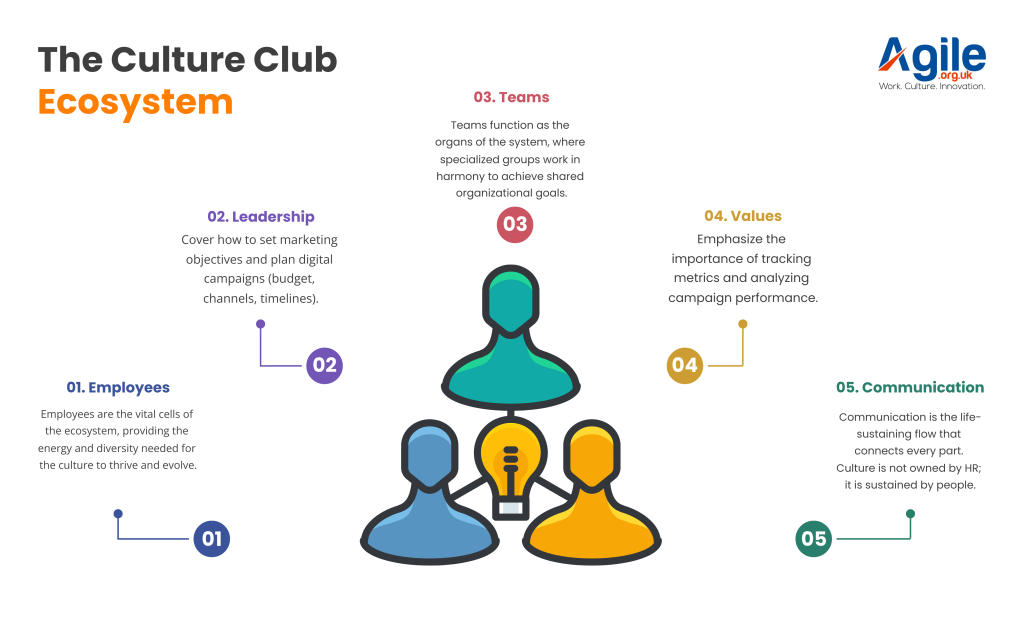
The most advanced organisations treat culture as a network rather than a department.
Think of:
• leadership setting direction
• employees shaping daily behaviours
• culture clubs connecting the system
In this model, culture emerges from everyday behaviour rather than from corporate messaging alone.
The Next Evolution: Culture Stewards
The future may move beyond a single culture club toward distributed culture stewardship networks.
These might include:
• culture ambassadors
• inclusion networks
• innovation communities
• wellbeing councils
• ethics circles within teams
Instead of one committee managing culture, the organisation becomes a living ecosystem of cultural guardians.
Summary
Just like agile working, culture clubs are emerging as an important mechanism for shaping organisational culture.
At their best they act as:
• translators of values into behaviour
• communication bridges between employees and leadership
• early warning systems for organisational health
• builders of community across the organisation
But they only work if they are trusted, representative and empowered to speak honestly.
The real opportunity lies in something bigger: turning culture from a corporate message into a shared responsibility.
Further Reading
• Gallup — Employee Engagement Research
• Harvard Business Review — Organizational Culture