
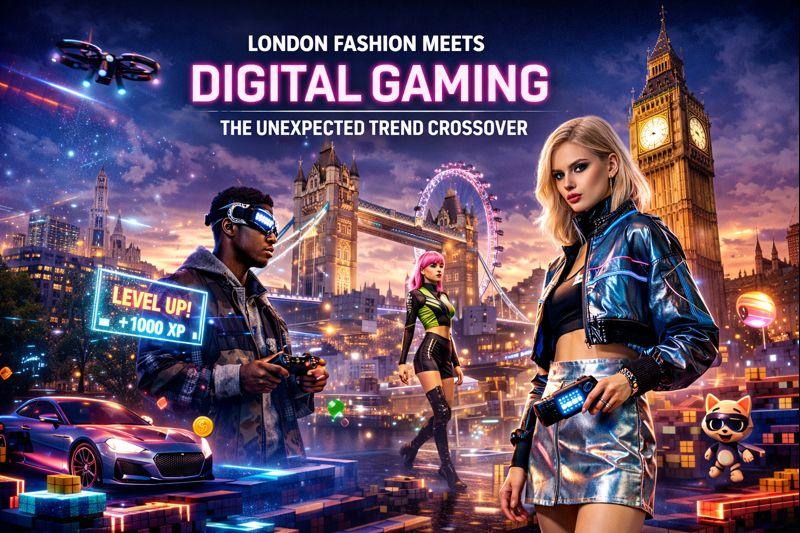
London fashion rarely borrows lightly. When it absorbs a visual language, it does so because the signal already carries cultural weight. Over the past year, digital gaming aesthetics have moved from peripheral reference to structural influence across parts of the London fashion ecosystem. Not as a novelty. As shorthand for speed, attention, and audience alignment.
This crossover did not emerge from experimentation alone. It reflects pressure. Pressure to hold attention. Pressure to speak to audiences shaped by screens, not ateliers. Pressure to remain visible inside a culture where visual literacy evolves faster than seasonal calendars.
Fashion did not move toward gaming to appear playful. It moved there to remain legible.
Where Digital Aesthetics Enter Couture Decision-Making
London designers now operate inside tighter creative margins. Collections compete not only with one another, but with feeds, platforms, and real-time cultural output. Visual clarity matters more than refinement alone. Gaming aesthetics answer that constraint.
Recent London shows reveal a shift away from subtle reference toward recognisable digital structure. Pixel grids appear not as prints, but as construction logic. Character silhouettes influence proportion rather than surface detail. Graphic contrast replaces embellishment in garments designed to register instantly, both on the runway and on-screen.
This is not nostalgia. It is an adaptation. Designers recognise that younger audiences read visual language differently. They respond faster to structured contrast and familiar digital cues than to abstract concepts alone. Gaming provides a shared reference system that compresses recognition into seconds, a principle rooted in visual communication in fashion where clarity determines whether a garment registers or disappears.
Adopt “High-Contrast” Project Management: Just as designers use pixel grids and primary blocks to separate form from background, use high-contrast visualization in your workflow. Your Kanban boards or project dashboards should be readable in seconds—if a stakeholder can’t “read” the status of a project at a glance (like a HUD in a game), the process is too subtle.
Pop-Up Culture and the Test of Physical Attention
The crossover becomes clearer in physical installations. Pop-up spaces across Soho and East London increasingly combine fashion display with interactive digital framing. These environments do not aim to explain collections. They aim to hold attention long enough for the work to register.
Installations built around digital motifs draw footfall because they mirror the environments audiences already navigate. Screens, lighting, movement, and sound form part of the spatial language. Fashion sits inside that language rather than standing apart from it.
One recent installation translated aquatic digital motifs into structured tailoring and surface texture, drawing on the same visual shorthand used in big bass bonanza, where colour depth and motion define the experience. The reference worked because it remained visual rather than literal. It signalled familiarity without requiring explanation.
Attendance figures matter less than behaviour. Visitors stayed. They photographed. They shared. The installation functioned as both showroom and distribution channel. That dual role increasingly defines successful fashion spaces in London.
Textiles Under Digital Constraint
Textile development shows the influence most clearly. London-based studios now design fabrics with digital environments in mind, not only physical wear. Pattern scale adjusts to screen visibility. Colour transitions sharpen. Geometry tightens.
Pixel-inspired repetition appears in woven silks and technical blends. Retro gaming motifs surface through grid logic rather than iconography. These fabrics perform across contexts. They read on the body. They read on camera. They survive compression.
Underwater colour ranges drawn from digital fishing and exploration environments influence palette decisions. Blue-green gradients, layered translucency, controlled shimmer. These choices stem from environments built to sustain visual interest over time. Fashion adopts them for the same reason.
Implement “Screen-First” Sampling: Fashion studios now design fabrics to survive digital compression. Apply this to your product development: build “Minimum Viable Visuals” first. If your concept doesn’t register clearly in a low-fidelity digital draft or a 15-second pitch, it likely won’t survive the transition to a saturated market.
Colour as Signal, Not Decoration
Gaming environments privilege colour clarity. London fashion mirrors this shift. Recent collections rely on high-contrast palettes designed to separate form quickly from background. Runways favour lighting that amplifies colour response rather than flattening it.
Evening wear absorbs digital logic through controlled gradients and reflective surfaces. Streetwear adopts primary blocks that recall early gaming systems without reproducing them directly. The reference remains structural.
These palettes travel well. They photograph cleanly. They translate across platforms. They survive retail lighting. Colour moves from ornament to signal, shaped by colour systems that prioritise clarity, contrast, and consistency across environments.
Shorten the “Visual Feedback” Loop: Move away from seasonal or quarterly planning toward “real-time cultural output.” Use digital mock-ups to test market resonance before physical production begins. The goal is to ensure the “signal” carries weight before you invest in the “texture.”
Virtual Presentation as Operational Tool
London designers no longer treat virtual shows as experiments. They treat them as distribution infrastructure. Digital presentations built inside gaming environments extend reach without diluting control.
Digital presentation now operates inside recognised cultural frameworks, not fringe experimentation. This shift appears in digital fashion exhibitions that treat virtual garments as curated objects, subject to selection, context, and display logic. The move signals maturity. Virtual presentation no longer proves possibility. It supports scale, access, and editorial control.
Garments appear on avatars that move through designed spaces rather than static frames. Viewers navigate the collection rather than watch it pass. This format changes audience behaviour. Engagement becomes active. Memory retention increases.
The advantage lies in access. Global audiences view collections simultaneously. No travel. No invitation gatekeeping. The format aligns with communities already accustomed to participation inside digital worlds.
The limitation also matters. Not every garment benefits from virtual translation. Texture, weight, and movement still require physical presence. Designers now choose what belongs in each environment. Selection replaces replication.
Treat Physical Spaces as “Beta Tests”: Use temporary installations (pop-ups) not just to sell, but to observe behavior. Use metrics like “dwell time” and “shareability” as primary KPIs over immediate sales. If visitors stay, photograph, and share, you have found a “visual shorthand” that works; if they don’t, you can pivot without the cost of a permanent lease.
Streetwear as Exchange Point
Streetwear carries the crossover most directly. London labels collaborate with game developers not to license logos, but to exchange visual systems. The result sits closer to fashion than merchandise.
Capsule collections influenced by gaming environments sell quickly because they resolve two pressures at once. They offer recognisable reference while meeting current standards of cut and material. This dynamic defines many gaming fashion collaborations, where exchange replaces branding and visual logic carries the value.
The exchange runs both directions. Gaming apparel has grown more refined. Fashion has grown more direct. Each absorbs constraints from the other.
Events that combine launches with gaming tournaments underline the shift. These gatherings collapse cultural separation. They create a shared space where visual language, not medium, defines participation.
Collapse the “Cultural Separation”: Like the streetwear brands collaborating with game devs, look for “exchange points” rather than mere sponsorships. Find partners whose visual logic matches yours. An agile partnership isn’t about slapping a logo on a product; it’s about exchanging systems (e.g., a software company adopting a fashion brand’s color palette for its UI).
From Screen Logic to Street Behaviour
London street style reflects the change without fanfare. Pixel detailing appears as an accent rather than statement. Digital silhouettes influence layering and proportion in ways that register subconsciously. This shift aligns with wider adjustments across British high street fashion, where speed of recognition and visual clarity increasingly shape what moves from screen logic into everyday wear.
Influencers accelerate the process by modelling integration rather than imitation. Successful looks borrow structure and colour logic without requiring knowledge of specific games. The aesthetic stands on its own.
Limits remain clear. Direct logos age quickly. Literal references narrow appeal. Designers who succeed understand where digital language stops serving fashion.
London fashion adopts digital gaming aesthetics for one reason. They function under pressure. In an environment shaped by speed, screens, and fractured attention, these visual systems deliver clarity without explanation. The crossover holds because it solves a real operational problem, not because it signals novelty.
Design for Active Navigation: Shift your marketing from static frames to “navigable environments.” Whether it’s an interactive PDF or a virtual showroom, ensure the audience is an active participant. Active engagement increases memory retention and provides better data on user intent than passive scrolling.